Material Form
Material Form defines the physical state in which a material exists as input to and output from a manufacturing process. The available material forms include:
- None: Represents the default state when no material form is specified or when the form is unknown.
- Bulk: Includes materials in loose forms, such as powders and liquids.
- Batch: Represents a set of materials combined in a batch.
- Sheet: Includes flat materials, such as paper, metal, or plastic sheets. Sheets can have properties like length, width, and thickness. This enables other dimensions, such as area and volume, to be calculated.
- Reel: Represents continuous sheet material wound into rolls or coils, such as paper, plastic, or metal. Width and thickness (depth) remain fixed, while length is measured when unwinding, enabling calculation of area and volume.
- Cable: Similar to a reel except the material has no width.
- Pieces: Represents discrete items or pieces, such as components, cans, and bottles, typically packed into boxes, cases, or pallets. Master data for the item details how many pieces must be packed.
- Single Piece: Represents individually tracked, single serialized items, usually high value materials tracked through a process.
Material forms can transition through manufacturing processes. The diagram below shows how such forms can translate from one form to another:
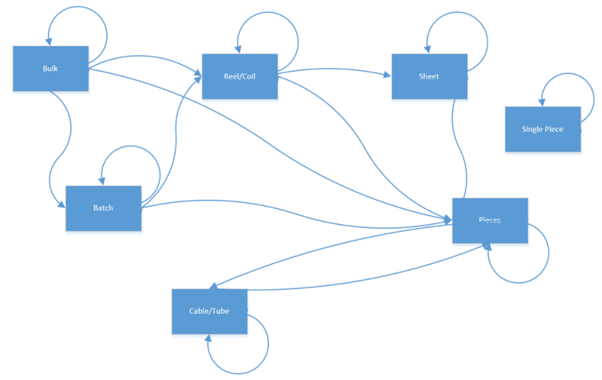
Each process type defines the input and output material forms. For example:
- A mixing process:
- Input: Bulk
- Output: Batch
- A packing process:
- Input: Pieces
- Output: Pieces
- A paper process:
- Input: Reels
- Output: Pieces