Bill of Materials
A Bill of Materials (BOMs) lists all materials required to produce the finished product. The BOM also specifies the quantity of each material required to produce one finished item. The BOM is defined at the production order level, and material requirements are calculated by multiplying each BOM item quantity by the production order quantity.
The application validates consumption to prevent incorrect materials being used. The list is hierarchical, because the finished product can be made from a combination of semi-finished goods and raw materials. The semi-finished goods can also be made from a combination of semi-finished goods and raw materials.
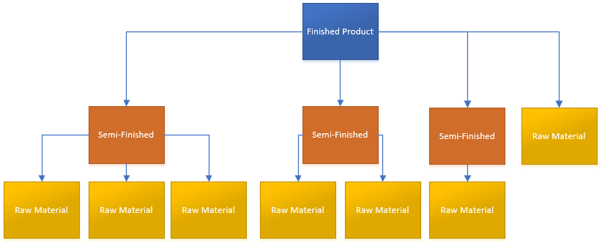
Each defined combination of BOM items is a BOM Variant. ERP does not tend to have an equivalent concept of BOM Variant – versions or revisions are the closest equivalents. In ERP, sometimes the BOM is stored directly against the material, meaning there is likely to only be one BOM variant in MES.
Sometimes ERP sends a new variation on the BOM with every production order. So there are multiple BOM variants in MES, each for the same material referenced by different production orders. This is referred to as the 'Actual BOM' or ‘Manufacturing BOM’, because ERP sends us the actual BOM for the production order.
When identical BOM variants exist, consolidation can be applied to replace duplicates with a single BOM, improving clarity and maintainability. When BOMs are imported from ERP along with the production order, this consolidation is typically automatically applied before the production order is released for execution.
One BOM variant must be designated as the default BOM, which serves as the primary BOM definition for the material.