Production Mode
Ordinarily all inventory is created for the material specified by the production order. However, some processes allow the simultaneous creation of multiple materials. These are the available production modes:
- Co-Production: A recipe production order represents the process executed on the production line. The material for the recipe order is not material that can be used to create inventory, instead, the recipe order represents the process. Production orders (receiving orders) are linked to the recipe order to book created inventory. The inventory created is expected to be based on the receiving orders.
- By-Production: The material for the production order defines the intended output of the process. However, the process can generate a different material as a by-product. See, By-Products.
- Grading: The material for the production order defines the intended output of the process. All inventory created from the process is the same material, however an additional grading property defines the quality of the material. Each grade of material can have a separate material number. However, this is based on the ERP configuration for the customer.
Note: This option is not supported currently.
These are the options available for each production mode:
- Standard: The application creates a single material for the production order.
- Graded: The application creates a single material for the production order, however, the created material receives a grading to describe the quality of the material. Grading is not implemented currently.
- Expected Co-Production: The application creates multiple materials for the production order, using a recipe production order to describe the process. The application records created inventory against predefined receiving production orders.
- Expected Co-Production (Position Restrictions): The application creates multiple materials for the production order, using a recipe production order to describe the process. The application records created inventory against predefined receiving production orders. The positions defined on the machine must match the ones on the production orders that are assigned to the recipe production order.
- Expected Co-Production (Width Restrictions): The application creates multiple materials for the production order, using a recipe production order to describe the process. The application records inventory against predefined receiving production orders. The total width of all receiving materials must be equal to or less than the width of the recipe material.
- Unexpected Co-Production: The application creates multiple materials for the production order, using a recipe production order to describe the process. The created materials are recorded against production orders, however, these orders cannot be predefined for the recipe order. The materials that can be created are restricted to production orders that include routing operations compatible with the machine. Additionally, the material properties must align with the properties defined for the material in the recipe production order, if they exist.
Expected Co-production
Co-production is used for processes that can produce different materials concurrently.
For example:
- Slitting a large reel into smaller reels of different widths.
- Heat treatment process in an oven where different materials are processed together.
- Creating paired components (for example, a left-hand and right-hand parts) in a single cycle, such as in a pressing process.
- Disassembly process where one input material results in multiple output materials.
These types of production orders are used to manage co-production:
- Recipe Order: The production order that runs the process. Only one recipe order can run on a single production line at a time.
- Receiving Order: The production order that receives the materials that come out of the process. A single recipe order can have one or more receiving orders. These receiving orders are assigned to specific positions and optionally, position groups in the recipe order.
If co-production is expected, the receiving orders are predefined and scheduled, meaning the output materials are known in advance. Like standard production orders, production runs are performed on recipe orders.
Assignment and configuration:
- Positions are defined on recipe orders to assign receiving orders.
- Receiving orders can be assigned to one or multiple positions on recipe orders.
- Each receiving order must include a phantom operation for the machine where the recipe order is scheduled.
The production that is recorded from a co-production run is reported as being created against the recipe order’s production run and created for the receiving order.
Recipe orders can be generated by ERP or can exist solely in the application. However, receiving orders are typically generated by ERP for inventory booking. Just like standard production order, output from co-production runs can be recorded using inventory packs or production counts.
Input inventory is consumed in the recipe order of the production run. The validation of input materials is performed against the bill of materials of the recipe order.
Inventory can be created in co-production and linked to the recipe order and the receiving order. This ensures complete traceability, linking the specific production run executed on the production line with the materials referenced in the receiving order.
Example: Expected co-production
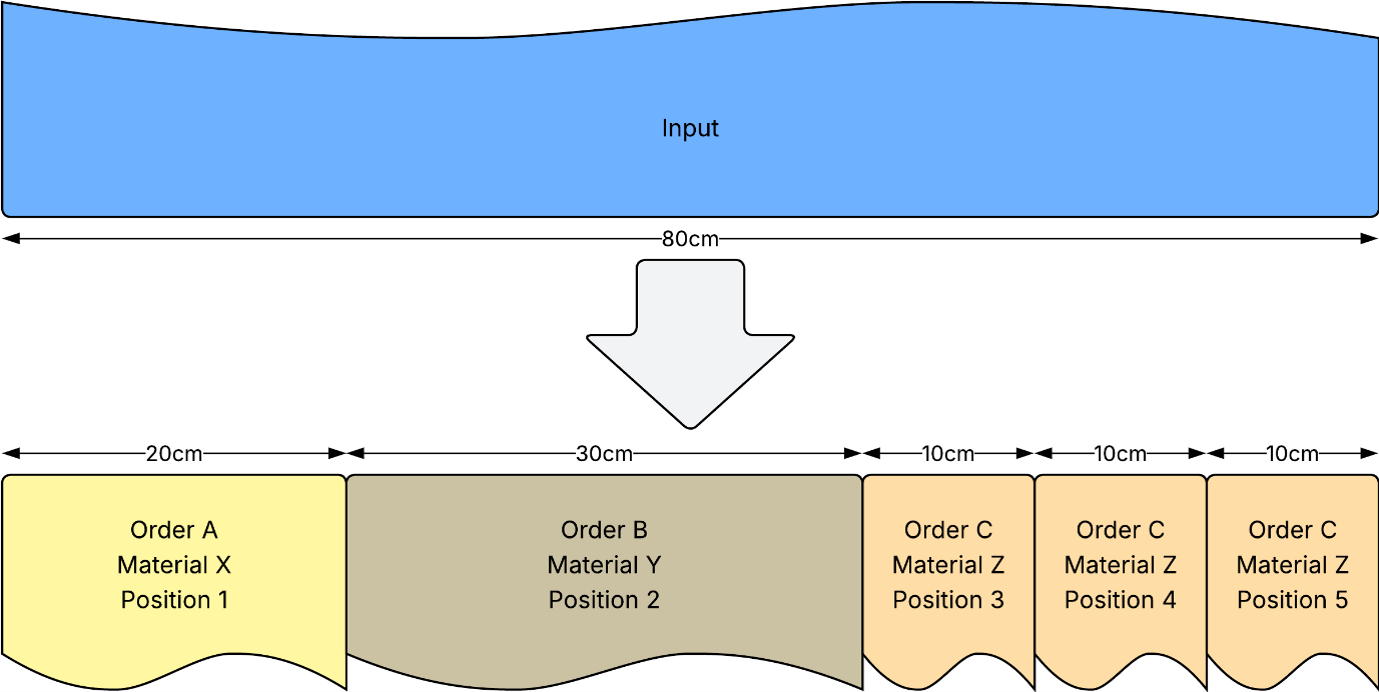
The following inventory pack is input into the process:
- Input material: Material A
- Material Form: Reel
- Width: 80cm
These receiving orders have been assigned to the recipe order:
- Receiving Order 001
- Recipe Order Position 1
- Material: X
- Width: 20cm
- Recipe Order Position 1
- Receiving Order 002
- Recipe Order Position 2
- Material: Y
- Width: 30cm
- Recipe Order Position 2
- Receiving Order 003
- Recipe Order Position 3
- Material: Z
- Width: 10cm
- Recipe Order Position 4
- Material: Z
- Width: 10cm
- Recipe Order Position 5
- Material: Z
- Width: 10cm
- Recipe Order Position 3
Unexpected Co-Production
The primary difference of unexpected co-production is that the receiving orders are not predefined, and therefore, are not scheduled with a recipe order.
The application supports such scenario through the following capabilities:
- Recipe orders can be started on a production line without assigned receiving orders.
- Recipe orders are not scheduled, allowing different receiving orders to be processed at different intervals. As a result, the recipe order often functions as a placeholder (dummy order).
- Receiving orders are indirectly linked to the recipe order in real-time as inventory is created or production counts are recorded on the production line. The receiving order must have a phantom operation for the machine on which the recipe order is currently running.
Similarly, to expected co-production, inventory consumption is recorded against the recipe order’s production run. The bill of materials must be defined on the recipe order to validate input materials. Created inventory is associated with the recipe order’s production run and the receiving order. This ensures complete traceability of the production activity and resulting materials.
Example: Unexpected co-production
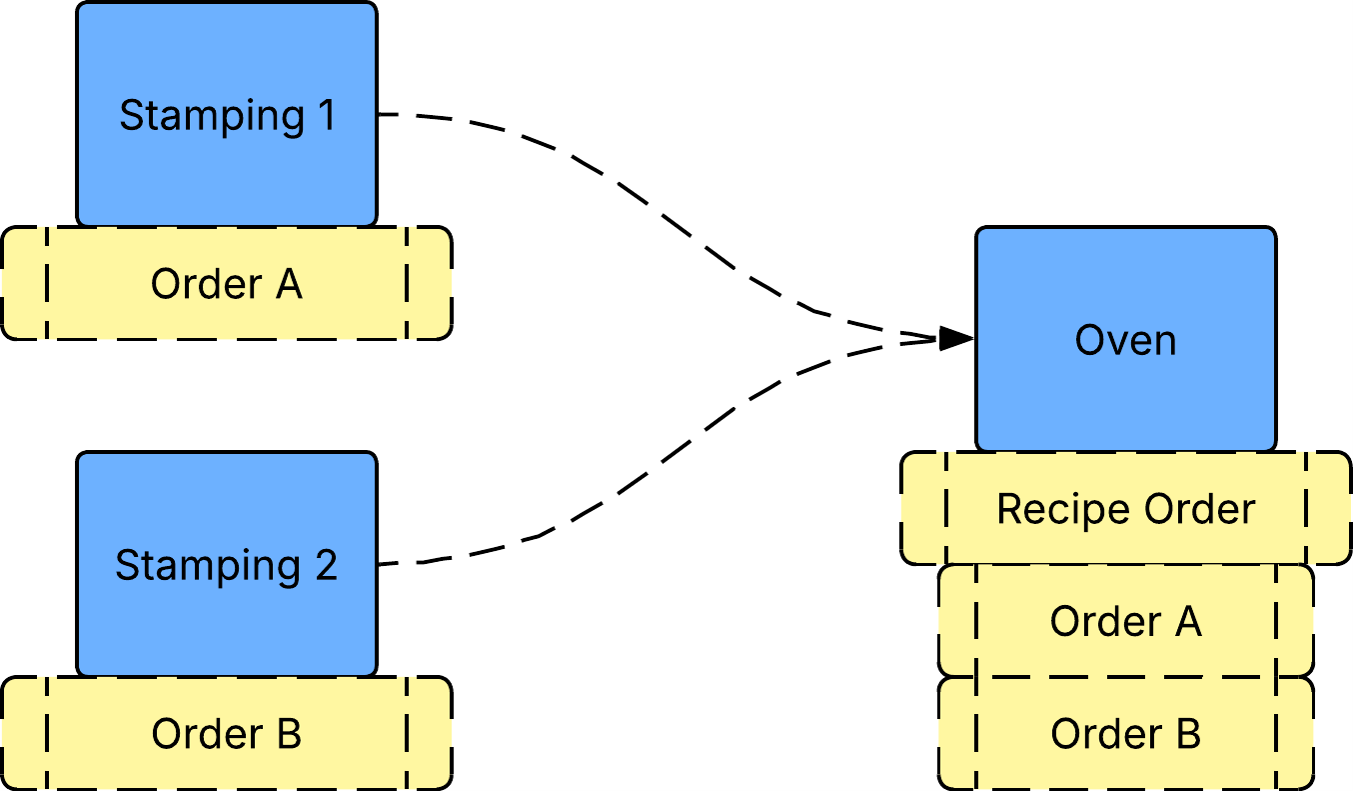
A heat treatment process using an oven is a typical scenario for unexpected co-production. This is because ovens often have the capacity to treat materials from multiple orders.
For example, there is a routing with two different operations: stamping and heat treatment.
- Production order A performs stamping operation on the Stamping 1 machine.
- Production order B performs stamping operation on the Stamping 2 machine.
After stamping, the items from both orders are sent to a single oven for heat treatment. Since the oven processes materials from multiple production orders together, unexpected co-production is required. This approach enables the oven to handle inventory from different production orders concurrently while maintaining accurate tracking and association with their respective production orders.