By-Products
By-products are defined as another item that is produced in the manufacturing process. By-products are optional outputs in the process, meaning a process may yield the product, however, production is not mandatory, although known to be possible.
In the application, such materials are defined as BOM items that are flagged as by-products.
- A negative quantity on the BOM Item often indicates a by-product in ERPs.
- Identification relies on the by-product flag, instead of the quantity.
- A by-product BOM item can be limited to a specific routing operation through the routing operation code, in the same way as consumed BOM items can be filtered.
Creating By-Product
To create a by-product inventory pack, the line's Process Type must allow by-product creation, and the BOM must include at least one BOM item flagged as a by-product.
Regardless of the inventory creation date mode defined in Process Types, by-production creation is always created in one step "Complete Pack". Depending on the process type configuration, by-product inventory can be created into a container, and a label can be printed.
By-product inventory packs are created at position 0 on the machine, with the inventory pack flagged as a by-product. By-products have the same state change handling as normal inventory packs.
For OEE calculations, by-products are excluded from the production output figures of the line.
Example By-Product
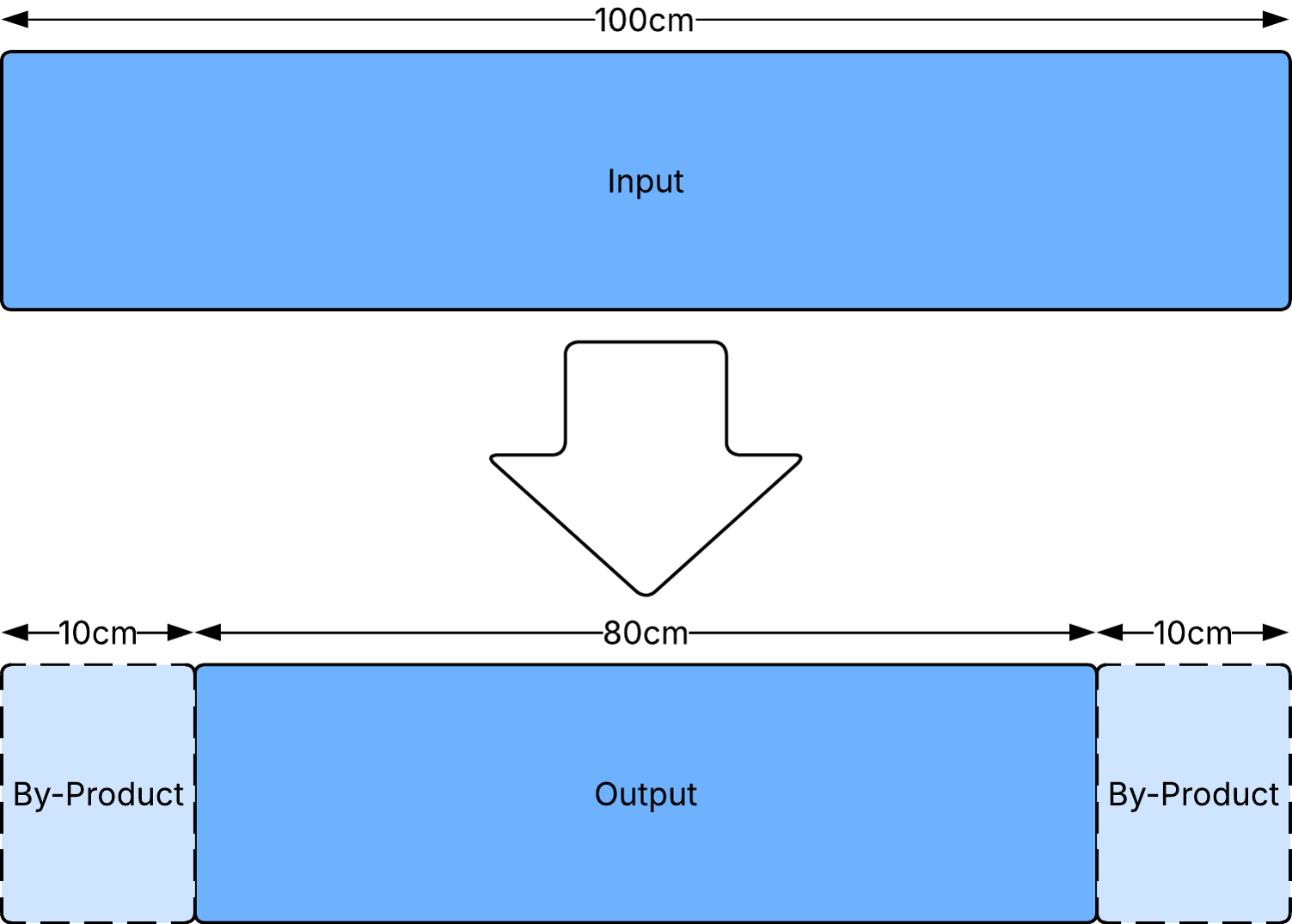
In a roll-to-roll process, an input roll can be trimmed to create a narrower output roll.
- Input material width: 100 cm
- Output material width: 80cm
- Trimmed material (20 cm total width) is recorded as the By-product.