Dimensions
Inventory pack quantity varies from pack to pack. For example, a roll of coated material or a length of cable can contain different quantities. In this case, Items Per Pack provides a standard or expected quantity. The user specifies the actual quantity when creating the inventory pack.
The dimensions of individual items in an inventory pack can be recorded using these fields:
- Mass Per Area
- The mass of an inventory item per unit area. This value represents the amount of material mass is distributed over a given surface area of the item. This is useful for thin materials or sheets where the thickness is minimal. For example, the mass per area of a sheet of paper is measured in kg/m².
- Density
- The mass of an inventory item per unit volume. This measure indicates how material is contained within a given volume. For example, the density of oil in a drum can be measured in kg/m³.
- Item Length
- The length of an inventory item. The length and width of an item can be used to calculate the area of an item. For example, the length of a wooden plank is measured in centimeters.
- Item Width
- The width of an inventory item. The length and width of an item can be used to calculate the area of an item. For example, the width of a wooden plank is measured in centimeters.
- Item Thickness
- The thickness of an inventory item. The value in this field is used to calculate volume and weight. For example, the thickness of a wooden plank is measured in centimeters.
- Item Volume
- The volume of an inventory item. This is calculated by multiplying the length, width, and thickness of an item. For example, the weight of a wooden plank is measured in cm³
- Item Weight
- The weight of an inventory item. This is recorded and calculated by multiplying the density and volume. For example, the weight of a wooden plank is measured in kg.
- Pack Height
- The height of an inventory pack from the base to the top. For example, the height of a pallet of bottles is measured in centimeters.
- Pack Width
- The width of the inventory pack. For example, the width of a pallet of bottles is measured in centimeters.
- Pack Depth
- The depth of the inventory pack. Depending on the orientation of the pack, depth can also be referred as length or thickness. Pack Depth, Pack Height, and Pack Width defines the overall three-dimensional size of the inventory pack. For example, the depth for a pallet of bottles is measured in centimeters.
- Packaging Weight
- The weight of the inventory pack's packaging material. For example, the weight for a pallet is measured in kilograms.
- Net Weight
- The net weight measurement of the inventory pack, excluding packaging. For example, the weight of four wooden planks.
- Gross Weight
- The total weight measurement of the inventory pack, including the contents and packaging. For example, the weight of four wooden planks on a pallet includes the weight of the planks and pallet.
Where configured, the applicable values in these fields are populated from the material record. You can override the applicable values when creating the inventory pack.
Master data supports conversions from one unit to another. For example, a reel as a length in meters (m) can be converted to weight in kilograms (Kg).
Examples
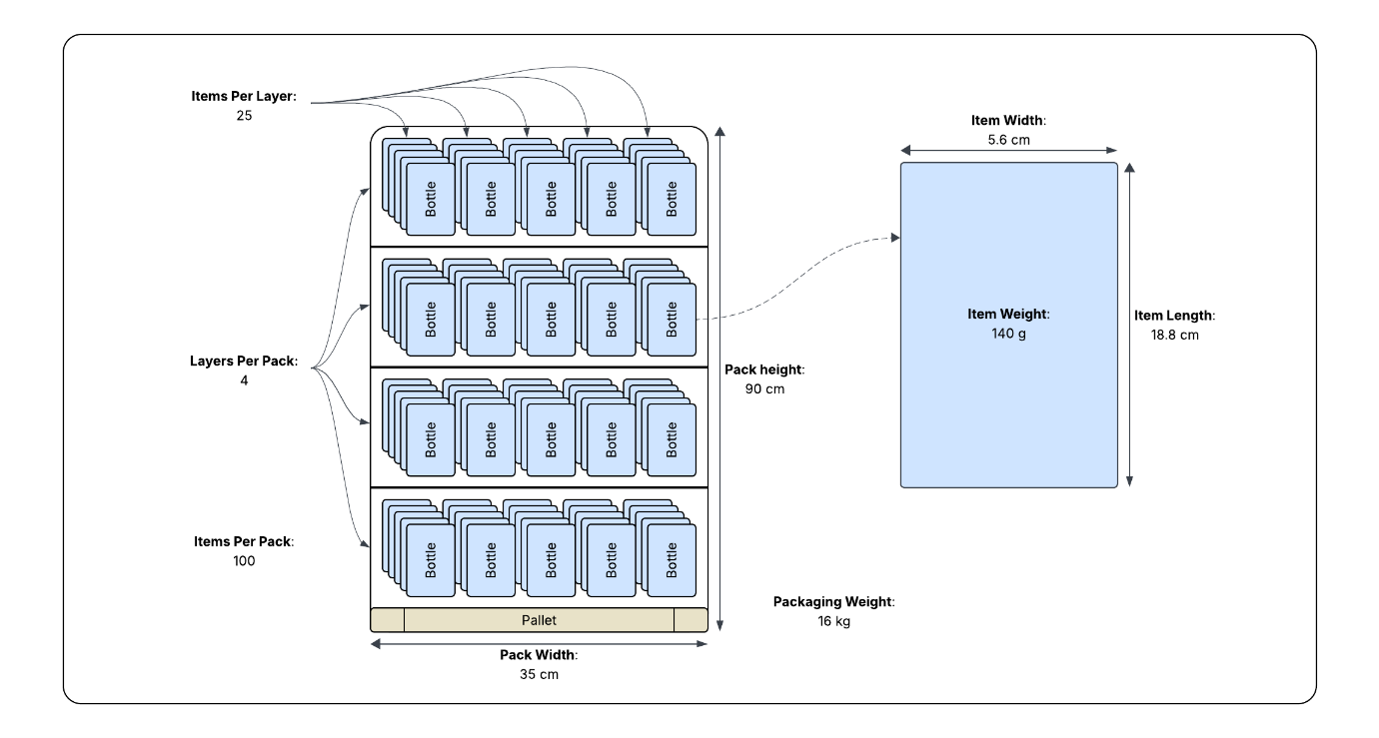
This example shows the configuration of a pallet of glass bottles:
The pallet contains four layers with 25 bottles in each layer:
- Items Per Layer: 25
- Layers Per Pack: 4
- Items Per Pack: 100
Each item (bottle) has the following dimensions and weight:
- Item Width: 5.6 cm
- Item Length: 18.6 cm
- Item Weight: 140 g
The inventory pack (pallet) has the following dimensions and packaging weight:
- Pack Height: 90 cm
- Pack Width: 35 cm
- Packaging Weight: 16 kg