Production Runs (Jobs)
Production Run (known as a Job) represents the execution of one or more operations on a production line to produce semi-finished or finished goods. This involves transforming input material into output material.
Specific operations are defined by the capabilities of the machines in the production line. A production order can be split into one or more production runs that are scheduled in sequence when allocated to a line ahead of time.
A production order may require multiple production runs for several reasons:
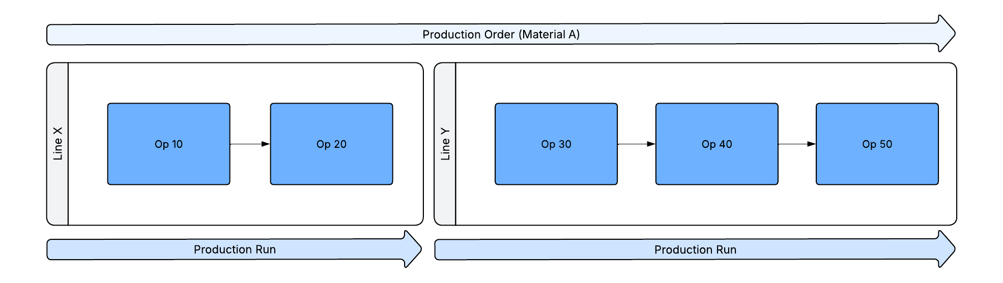
- The routing includes operations performed by multiple lines, resulting in one production run per line.
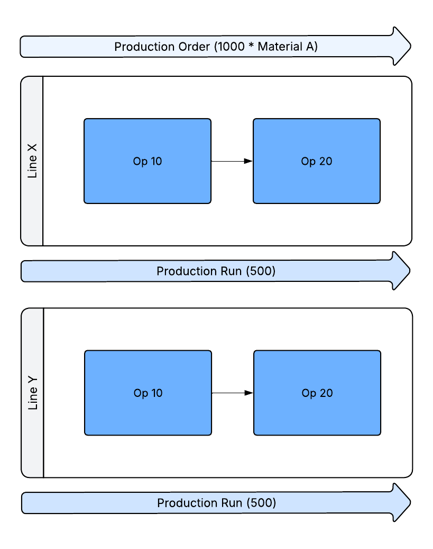
- Load is spread across multiple pieces of equipment for one order, with parallel production runs being executed on different lines.
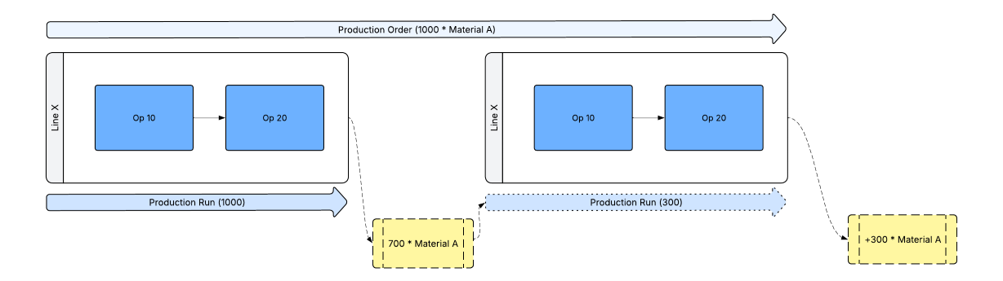
- The total order quantity is split into smaller quantities to produce in a series of production runs over time. These production runs can be interlaced with production runs from other production orders.

- A job can be completed before producing the full order quantity. The remaining quantity can be rescheduled as a new production run for the same production order.
Production runs are central to the application, as most operational data is connected at the production run level. This includes:
- Material consumed during the process
- Material created out of the process
- Intermediate inventory tracked between operations
- Counts of material created, scrapped, or reworked
- Quality test results captured
- Process parameters automatically recorded
- Tools loaded into machines
- Downtime (overlapping production runs)
Scheduling a production run involves the following steps:
- Allocation of the production line that executes the production run
- Definition of the sequence in the queue that the production run is to be executed on the production line
- If this is the first scheduled job for the production order, the production order status is updated to Scheduled.
The estimated duration of each production run in the schedule is automatically calculated using these parameters:
- The target cycle time of the bottleneck operation
- The required quantity for the production run
- The budget efficiency for the production line, accounting for non-ideal operating conditions.
See Scheduling Engine.
Once a production run is scheduled, modifications can be made prior to execution, such as reassigning the production run to a different production line, or updating the sequence within the schedule. Before execution, the production run must be released. This release can occur during scheduling, or as an independent action performed at a later stage.
After release, the production run can be started manually by an operator (typically from a dashboard), or automatically through trigger, such as a PLC signal. Once execution has started, no further changes can be made to the production run details.