Job Dependencies
A job dependency is created between two otherwise unrelated production runs, if material produced in one production run is required by a subsequent production run. For example, a finished-goods order can require semi-finished goods to be produced beforehand.
Semi-finished goods production orders can also consume other semi-finished materials; dependency chains can extend across multiple production levels.
During scheduling, job dependencies are automatically added between production runs on different lines relating to the same production order as part of the scheduling process. If a routing indicates that the operations in a routing are carried out by different lines, then a dependency is added to indicate that order progression must observe operation sequencing.
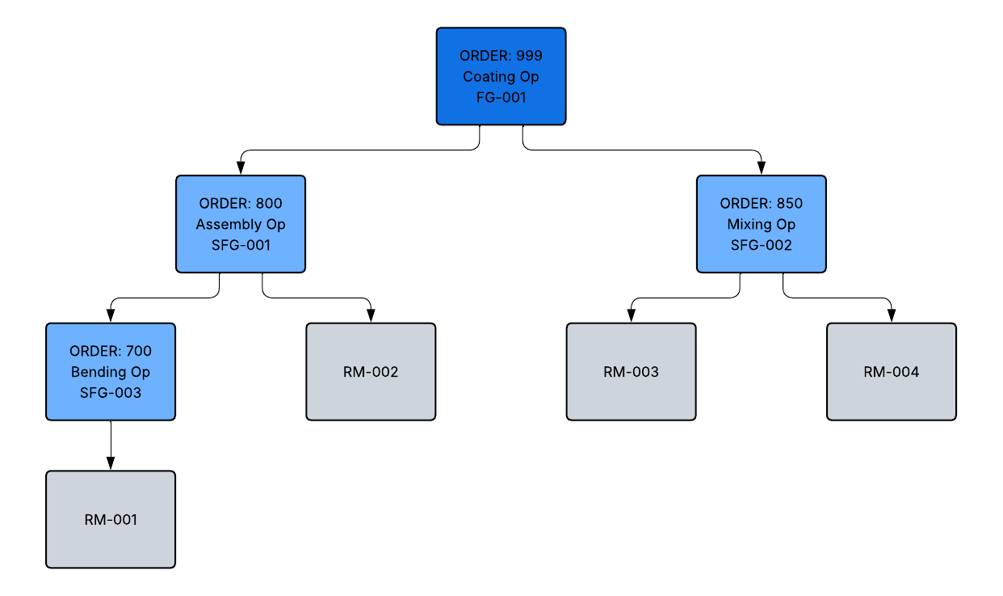
These dependency relationships can be established:
- Predecessors: A production run that must occur before the current production run. If the current production run depends on a previous production run, then the previous production run is the predecessor.
- Successors: A production run that depends on the current production run. If a future production run requires completion or progress of the current run, then the future production run is the successor.
Dependency Types
These job dependency types define the dependency relationships between production runs:
- End-Start: The current production run can start only after the predecessor has ended.
- Start-Start: The current production run can start only after the predecessor has started.
- End-End: The current production run can end only after the predecessor has ended.
- Start-End: The current production run can only end after the predecessor has started.
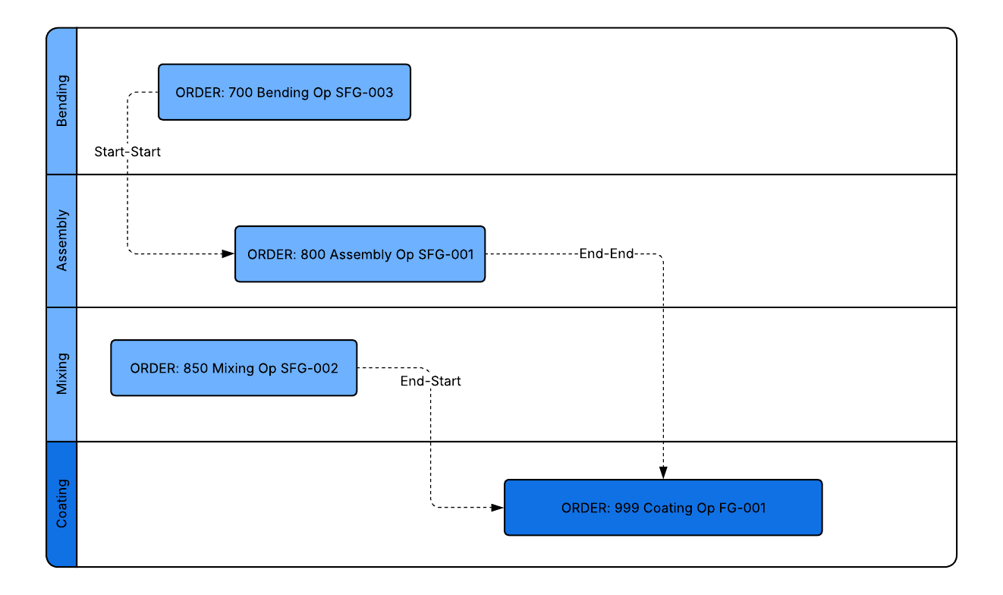
Delays
Delays can be established using these options, where N is a specified value:
- End-Start: The current production run can start only after at least N minutes after the predecessor has ended.
- Start-Start: The current production run can start only at least N minutes after the predecessor has started.
- End-End: The current production run can end only at least N minutes after the predecessor has ended.
- Start-End: The current production run can only end at least N minutes after the predecessor has started.
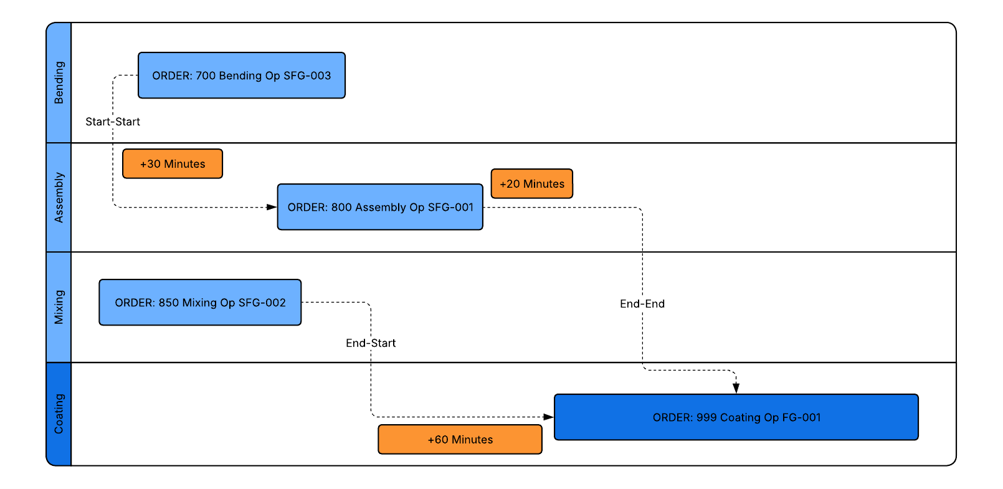
Rescheduling
Rescheduling a production run with dependencies automatically adjusts any dependent production run, if required. The production order sequence is used to maintain the correct execution order of production runs and ensure dependency constraints remain satisfied.