In-house Package Management Overview
The purpose of in-house package management is to manage packages as logistical and storable units throughout the warehouse flow. This functionality includes inbound and outbound processes, and internal warehouse activities. The functionality is usually called "in-house package management" or "Package in Stock".
To improve efficiency in warehouse and distribution center operations, organizations store and transport goods in packages.
The same packages are used throughout the supply chain, such as between manufacturers, suppliers, forwarders, and customers. Across the supply chain, from the manufacturer to the end consumer or retail store, using the same package helps avoid repacking and relabeling.
A manufacturer initially creates or assembles a package and its contents. A central warehouse or distribution center can then receive, cross-dock, store, and ship the package before the consignee receives it. Many central warehouses and distribution centers use cross-docking instead of storage. This process increases the requirement for fast and accurate identification of inbound packages.
Keeping the package identity unchanged throughout the supply chain avoids repacking and relabeling. Consistent package identification also supports communication and traceability across supply chain partners.
The main principle of in-house package management, or package-in-stock management, is that the package remains closed. The package is received, stored, moved, and dispatched as is.
- Maintenance of detailed package information throughout the supply chain
- Inbound processes
- In-house processes
- Outbound processes
- Receiving package information through:
- Advanced Shipment Note (ASN) for purchase orders
- Manufacturing order reporting
- Inbound distribution orders
- Manual packing and unpacking
- Managing package structures with multiple levels in the warehouse
- Using package information during picking and dispatch
- Supporting package-based warehouse operations, such as stock take and physical inventory
Rules
A package in stock has these characteristics:
- A package in stock can contain a mix of item numbers and lot numbers, but it is not required to contain both.
- A package in stock can contain only items that are package-managed.
- A package in stock can contain one package or several packages, but it is not required to contain packages.
- A package in stock can be empty.
- A package can be connected to a delivery, but it is not required to be connected to a delivery.
- When you receive a package that is connected to an inbound delivery and place the package in stock, the package is disconnected from the delivery and becomes a package in stock.
- When you pick a package in stock for an outbound delivery, the package is connected to the delivery.
- An in-house package does not have a location. The location of a package in stock is determined by the location of the package content.
- All stock balances that are connected to the same package must have the same location.
- A package in stock can exist only at a location that uses container management.
Processes involved
This diagram shows the main warehouse activities in which package management is used.
The package management solution is designed so that most activities can be performed through an external system, such as a handheld device, by using an API.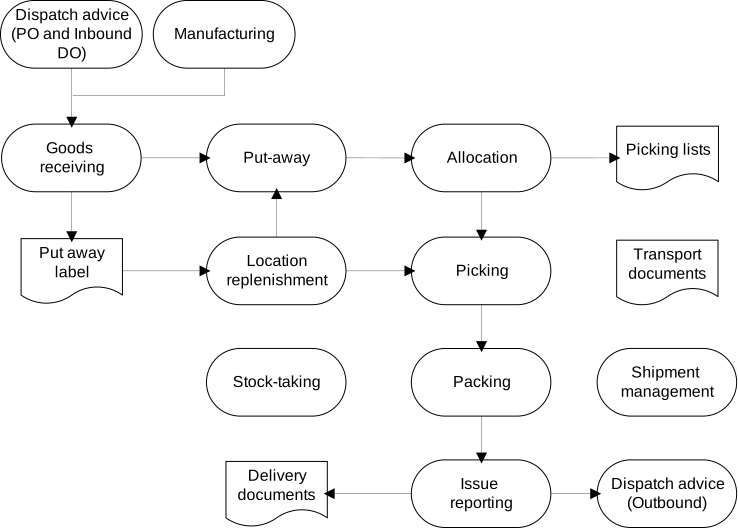
Architecture
This diagram shows the architecture of in-house package management and the associated elements.
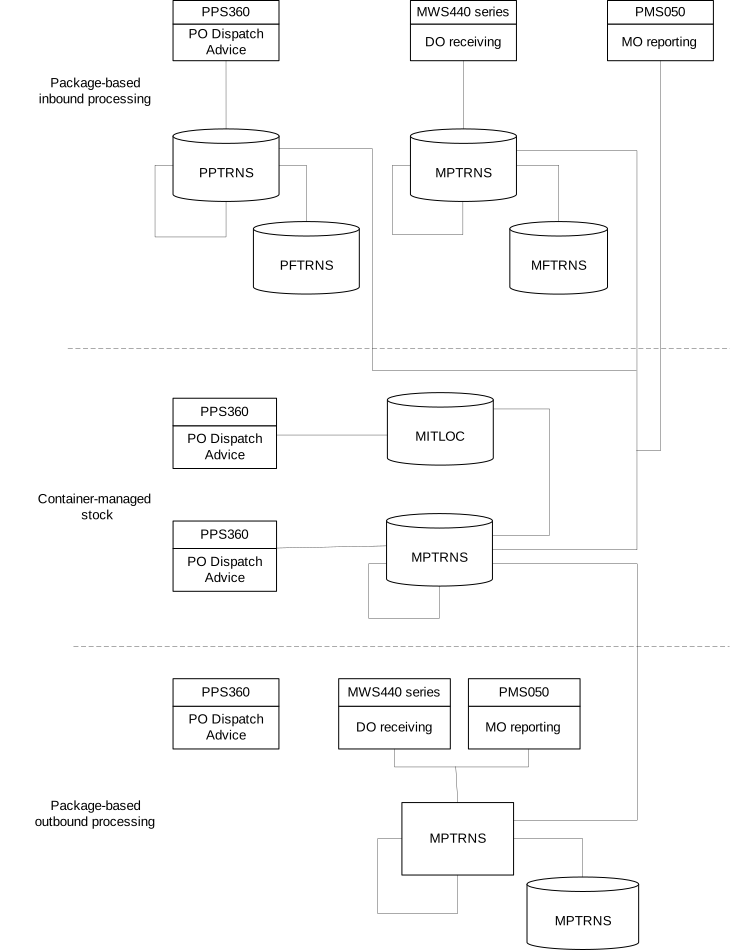
The MPTRNS file stores packages in stock.
- The delivery number field (DLIX) is 0.
- The disconnected package field (DIPA) is 1.
- The direction field (INOU) is 0.
- The warehouse field (WHLO) is blank.
The contents of a package in stock are stored in MITLOC. The container field (CAMU) represents the package number.
The outermost package in a package structure is stored in the Outer Package Number field (OPAN) in MITLOC and MPTRNS. For a balance identity or a package that is not contained in another package, the outer package number is the same as the package number in the PANR or CAMU field.
A package in stock can exist only at a location that uses container management (MITPCE record).
In the dispatch flow, a package in stock can be transferred to a package on a delivery. The existing in-house package record in MPTRNS is updated, and no new MPTRNS record is created.
- The delivery number field (DLIX) is set.
- The disconnected package field (DIPA) is 0.
- The direction field (INOU) is 1.
- The warehouse field (WHLO) is set.
Limitations
- Do not repackage an in-house package on a dispatch flow.
- Transfer an in-house package to a delivery by using the auto pack option.
- In-house packages have no location.
- We recommend that you use a packaging type with auto deletion when the package is emptied.
- During inbound purchase order (PO) receiving, to enable a package-based receipt and create a package in stock, you must create the delivery note in 'Supplier Delivery Note. Open' (PPS360) from 'Order Init Stock Msg. Manage' (MHS850) with qualifier 29. A delivery note that 'Purchase Order. Advise Shipment' (PPS260) creates does not support this process.
- Purchase Direct Putaway cannot be used to receive and retain packages in stock.
- Automatic allocation is not package-based, but on the balance ID. Automatic allocation can allocate the contents of a package in stock when the package contains a single item and fixed quantities are used for each package. An item-level setup in 'Item. Connect Stock Location Type' (MMS057) is required.
- You cannot use Auto DO Receipt with an in-house package.